 All projects
August 2026· Tripoli L1 certified
High-Power Rocket
A modified LOC IV, an H motor, and a Tripoli Level 1 certification.
- Rocketry
- Tripoli L1
- OpenRocket
- High Power
This is the flight that earned my Tripoli Level 1 certification — the first rung of high-power rocketry, and the one that unlocks H and I class motors. The rule is simple and unforgiving: build it, fly it on an H or an I, and recover it in flyable condition. One flight, witnessed, no second attempt on the same airframe if you break it.
The airframe
It started as a LOC Precision IV kit and got modified in two ways, both aimed at the same thing.
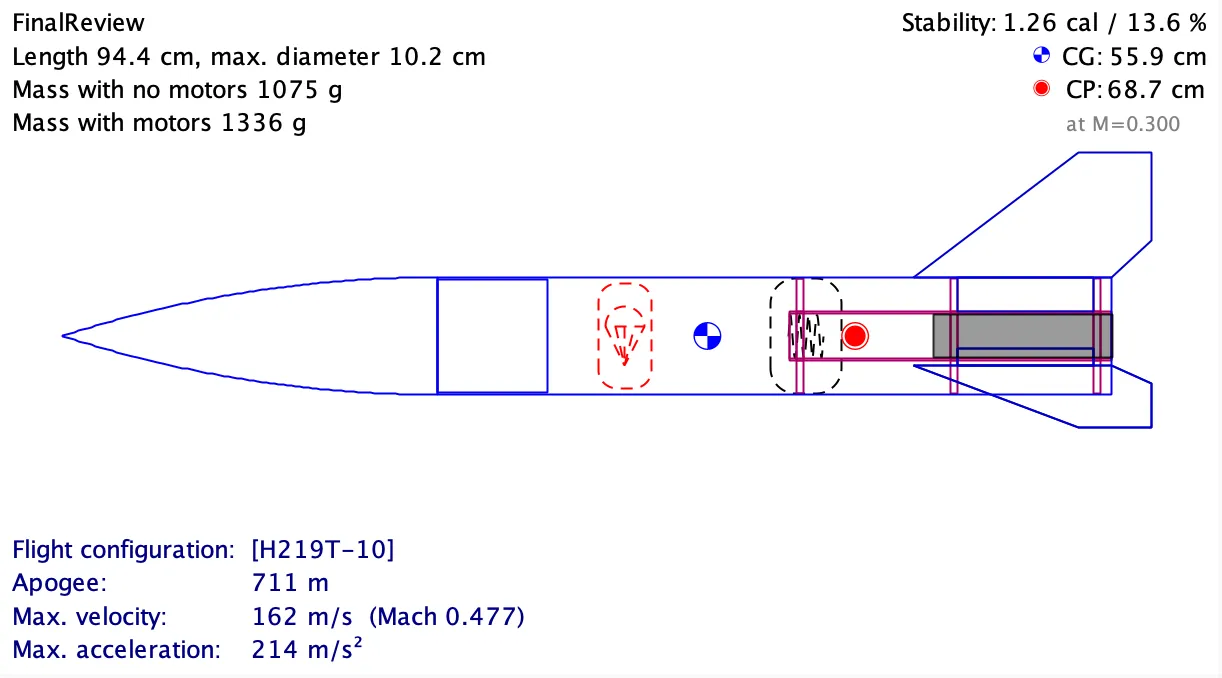
The payload section came off, and weight went into the nose cone. Together those move the center of gravity forward, which is the whole game — a rocket is stable when its CG sits ahead of its center of pressure, and it weathercocks into the wind or tumbles when it doesn't. Stripping the payload bay shortens the airframe and takes mass out from behind the CG; nose weight adds mass in front of it. The simulation put the finished rocket at 1.26 calibers of margin, which is comfortably inside the rule of thumb that you want at least one caliber and rarely more than two.
The numbers
These are the predictions out of the OpenRocket model I flew against, not telemetry — with the payload section removed there was nowhere to put an altimeter, so the sim is the only record of what the flight should have looked like.
- Motor — H219T-10
- Apogee — 711 m
- Max velocity — 162 m/s, Mach 0.477
- Max acceleration — 214 m/s²
- Length / diameter — 94.4 cm / 10.2 cm
- Mass, dry / loaded — 1075 g / 1336 g
- CG / CP — 55.9 cm / 68.7 cm
- Stability margin — 1.26 cal (13.6%)
The -10 on the motor designation is the ejection delay: ten seconds between burnout and the
charge that pops the chute. That number gets picked to fire at apogee, where the rocket is moving
slowest and the parachute has the least to fight. Too short and you deploy into the climb; too long
and it's already nose-down and picking up speed.
What's next
Level 2 is the near-term goal. That means a written exam on high-power safety and regulations, and a flight on a J, K, or L motor — a jump in impulse that puts the next airframe well past what a modified LOC IV will take.